RESPONSIBLE HORSE OWNERSHIP
By
Eleanor Richards
Copyright©2007
LESSON
ONE
PART
ONE: YOUR SAFETY:
Horses are not 1,000-pound dogs.
Horses
react very quickly to outside stimulation.
They will run from something that frightens them. Once a horse reaches
what is thought to be safety, he’ll usually stop, turn and look at the
perceived monster. If a human happens to
be between him and safety, he won’t hesitate to run over the person. You must be alert at all times.
All
horses kick. If a horse is startled, a
kick may quickly follow. Horses will
kick in play or aggression.
When
grooming a horse, if a tool is dropped, do not bend over to pick up the
item. Use your foot to move it to the
side, into a safe zone before you retrieve it.
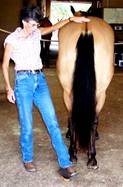
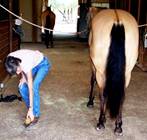
Move the brush from behind
horse.
Now pick it up.
If
a horse must be approached from the rear - speak first. A firm “whoa” when approaching a horse from
the rear may avoid a kick. When walking
behind a horse either stay very close to the hindquarters, with a hand on the
rump, or move into an area beyond the reach of a fully extended kick.
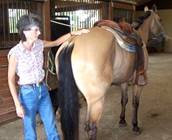
Walk
behind a horse close and with a hand on the rump.
When approaching a horse from the front, do not run up to him. Walk quietly and speak in a calm voice so he
is aware of you. Approach him to the
left or right of center – toward his shoulder is best. Do not extend your hand directly toward his
face or muzzle; place a hand on his shoulder, while saying “whoa”.
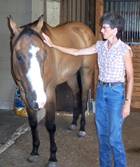
Approach
a horse from the side.
Avoid being with a horse when he is loose. It is very dangerous to be in a pasture with
a loose horse…it is even more dangerous if there are several horses. The risk of being run over or kicked is very
high when horses are running free.
Carrying a long stick or whip will help keep them back. Do not carry grain or hay while in a pasture
with a loose horse…this is sure to get you injured. Stay alert.
Jan is an experienced horsewoman.
One afternoon she was doing her routine chores. The horses were in the back pasture so she
opened the gate to let them come to the barn.
As they came through the gate one of the horses playfully kicked….and
caught Jan on the side of the head. She
suffered a broken jaw, lost several teeth and had damage done to the bone
structure around her eye.
Beware of a biting horse. Horses
must complete the biting act. Once a
horse starts to close his mouth the action must be carried through – he cannot
open his mouth in mid-bite. In addition
to this, if a horse has been disciplined many times, he may bite and jerk
away…this can leave a nasty wound or bruise on you.
The 2-year old stallion being
lunged was doing a good job for a young horse.
Tom stopped him and approached the youngster to pat him on the
neck. The colt reached out and grabbed
Tom’s hand with his teeth. When Tom
removed his glove he discovered the tip of his middle finger was missing.
When walking down the aisle way of a barn
where horses are hanging their heads out of the stalls, be very careful a horse
does not reach out and make a grab at you.
Learn to read horse body language.
Horses will usually send signals before committing an act. It is important to learn these signals and
know how to re-act to them.
The most obvious form of horse communication is the ears. A horse with his ears pinned back against his
head is an aggressive horse. It is not
be a good idea to approach this horse with an extended hand – a finger might be
lost.

Ears
back; Stay away!
A
cocked back leg accompanied with pinned ears is sure to be followed by a kick.
Browse around the internet or look at a book with pictures of people 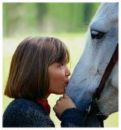 interacting with horses. Invariably you will see a photo of a girl
kissing a horse on the end of the nose.
This is a great way to get a broken nose or a few loose teeth. The bone within a horse’s head is extremely
hard. If the horse being kissed flips
his head, the kiss will quickly be forgotten.
If you want to show your horse affection – scratch him along the
withers.
interacting with horses. Invariably you will see a photo of a girl
kissing a horse on the end of the nose.
This is a great way to get a broken nose or a few loose teeth. The bone within a horse’s head is extremely
hard. If the horse being kissed flips
his head, the kiss will quickly be forgotten.
If you want to show your horse affection – scratch him along the
withers.
Never tie yourself to the horse or wrap the end of the rope or reins
around your hand. There are times when
getting away from the horse is the best thing for all concerned.
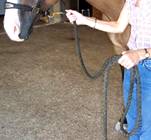
Lead
rope held properly; not wrapped around hand.
Kate and her
sister were riding their horses in the woods.
Kate dismounted to remove some debris blocking the trail. She tied her horse’s tie-rope around her
waist so he wouldn’t wander away. A
movement in the woods spooked her horse and she was drug to her death, while
her sister watched.
When leading a horse, walk next to him, with
his throatlatch (where his head attaches to his neck) opposite your
shoulder. Do not walk directly in front
of him, while he drags along behind you.
If he is behind you and something spooks him he will jump directly on
top of you. Proper leading will be
addressed in a later lesson.
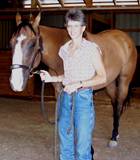
Proper
leading position – next to the throatlatch.
NEVER work with a horse unless you have
a halter and lead rope or bridle on him.
Working with a horse "at liberty" is a sure way to get
hurt.
Protective
clothing is a must.
Boots are not a fashion statement, they serve a purpose. The leather provides a protective barrier
between a hoof and a toe. Granted being
stepped on will still hurt, but less damage will result if you are wearing
boots rather than tennis shoes or sandals.
Footwear designed for riding can keep your foot from sliding through the
stirrup or iron.
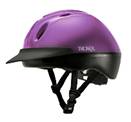 Riding helmets have been discussed in-depth in all horse riding
disciplines. It all comes down to one
fact – they do save lives. It is
recommended an ASTM/SEI (American
Society for Testing and Materials/ Safety Equipment Institute) approved helmet be
worn while riding. Yes, they are hot;
they look funny while riding a western horse and it’s not “macho”, but there
are some cool colors and cool styles available.
Riding helmets have been discussed in-depth in all horse riding
disciplines. It all comes down to one
fact – they do save lives. It is
recommended an ASTM/SEI (American
Society for Testing and Materials/ Safety Equipment Institute) approved helmet be
worn while riding. Yes, they are hot;
they look funny while riding a western horse and it’s not “macho”, but there
are some cool colors and cool styles available.
Gloves are not mandatory, but can protect your hands while working
around horses. The feeling of having a
lead rope slide through your bare hands, as the horse is spooking at a blowing
plastic bag, is not pleasant.
PART TWO: YOUR
HORSE’S SAFTEY:
Horses are large animals and have a flight instinct…when frightened,
they run. These two characteristics can
make dangerous situations worse.
Throughout the course you will learn why horses need to be trained
properly so they are attentive in dangerous situations…willing to listen and
respond to cues when in times of crisis.
Proper training aids in avoiding dangerous situations.
Your horse’s surroundings must be horse-proof. Stalls, fences, pastures and passageways must
be structured and maintained with your horse’s safety in mind. You must be observant at all times - repair,
remove and avoid unsafe situations.
Stalls and pastures should not have protruding boards, nails or other
items which can harm your horse.
Construction gaps large enough for a foot or head to be inserted should
be repaired. Feeders and waterers should be horse safe. The stall flooring should be textured so your
horse can stand without slipping (rubber mats or clay is best – avoid
concrete).
Passageways or barn aisles should be clear and wide enough for you and
your horse to pass safely. Tools, such
as wheelbarrows and manure forks, should be put away.
Latches on doors and gates should be latched
back so your horse cannot catch on them when passing through. Make sure the door or gate is open all the
way before leading the horse through.
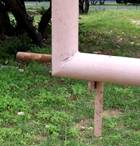
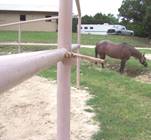
Dangerous gate latch.
The same gate with handle not locked down.
In
later lessons we will learn about safe fences and proper stabling for horses.
Common sense around horses is an important
virtue. When around horses you must be
alert and aware of their movements at all times. If someone puts you or your horse in a situation
you feel is unsafe, do not be shy; speak up and protect yourself and your horse.
Do
not put your horse in an unsafe situation.
Think before acting.
Butch's wife called to him from the
house – he had a telephone call. Butch
was just about to put the bridle on his saddled horse. Instead of tying the horse in a safe area, such
as his stall, he turned him loose with the saddle on. When Butch returned to the paddock the horse
had caught his hind foot in the flank strap, panicked and crashed through the
fence - getting severely injured.
If you are taking this course in preparation
to own your first horse, please stay safe while searching for your first
horse. Observe the owner handling and
riding the horse. Take an experienced
horse person along for advice. This is
also a great opportunity to inspect stables and make notes about what to avoid
and what to implement in your future horse’s stable.
Throughout the course “safety alerts – SA” will be
pointed out.
______________________________
If
you would like to continue with the rest of the lessons in
Responsible Horse Ownership:
Upon completion of the course you will receive a certificate of
achievement. During the course the
instructor, Eleanor Richards, will grade your quizzes, reply to any questions
and assist you in learning about horses.
You will have Eleanor's email address for any questions during and after
the course. For more information about
the Responsible Horse Ownership course Click Here.